Ecuador Post 2
Guayaquil

Hello there,
Back to it!
After an initial panic regarding the missing passport, I actually slept pretty well (not due to solving the problem, but rather as a result of my aptitude for pretending problems don’t exist, especially when a good night’s rest hangs in the balance).
And now, you may breathe. Morning alighted, and with it, answers.
My passport was simply down at the reception desk. As it turns out, I had handed it to the concierge for check-in, and he had forgotten to hand it back. That’s the framing he used when he returned it super apologetically the next morning, and accordingly, with that in mind, no blame for the passport’s disappearance will be allocated to me at this time, or henceforth. Thank you.
Prudence is a virtue I typically try not to practice, but my two full days in Guayaquil involved a lot of it. For example, acting against my nature, I stayed close to the hotel, avoided certain areas, and forswore nighttime outings.
Still, I managed to see some interesting things: the Catedral Católica Metropolitana de Guayaquil (and adjacent Iguana Park), the Malecón riverside boardwalk (which had a full-sized rollercoaster carrying exactly one rider, a woman who sat up front and screamed so incredibly loudly… just absolutely hollering… probably the loudest noise I’ve ever heard a person make), and the famous Las Peñas neighborhood. Las Peñas is where the city of Guayaquil began. It’s situated on a mountain slope, such that the houses jut out like drawers. In light of this prominent, high-visibility position, aesthetically minded government officials provide free bright-colored paint to any residents who will use it on their homes. Or maybe they offer a stipend to people who paint their homes a cool color (cool as in awesome, not tonally cold)? The details are a little fuzzy, as I received them from Nervous Ed, with whom I met up for a walking tour hangout. Regardless, the cumulative effect of the neighborhood is quiltlike and wonderful, rainbowy, reminiscent of a beehive.
Here are other things I learned from Nervous Ed that may not be accurate, listed in descending order of confidence I have in them. No need to fact-check, please:
In the year 2000, Ecuador underwent dollarization, a process by which other nations adopt the U.S. dollar as their currency. So the bills here are the same as in America! They do have their own coin system, which is sort of a delightful state-sanctioned counterfeit, because acquiring enough authentic quarters/dimes/nickels/pennies would have been prohibitively expensive, a logistical nightmare, and, most damningly, zero fun. Like any good social contract, the system works because everyone buys into it and decides together that it will work.
Other countries that have dollarized are Panama, Timor-Leste, Zimbabwe, and Palau. I googled these actually, Eduardo didn’t have them memorized. And I don’t want to spoil anything, but there are even more, if you care to google as well.
There used to be a bridge spanning the Guayas River—of aforementioned riverside boardwalk fame—but a Brazilian naval ship collided with and destroyed it. Instead of constructing another boring replacement bridge, the government installed a gondola network (these are the ski lift-adjacent, enclosed-box-on-wire gondolas, not the romantic Venetian rowboats). And people use them to commute! How neat is that? Pretty neat, I’d say. Imagine floating through mist every morning before work. It reminds me of the fact that some puckish New Yorkers commute via the Staten Island Ferry, or the Roosevelt Island Aerial Tramway, or a motorized skateboard.
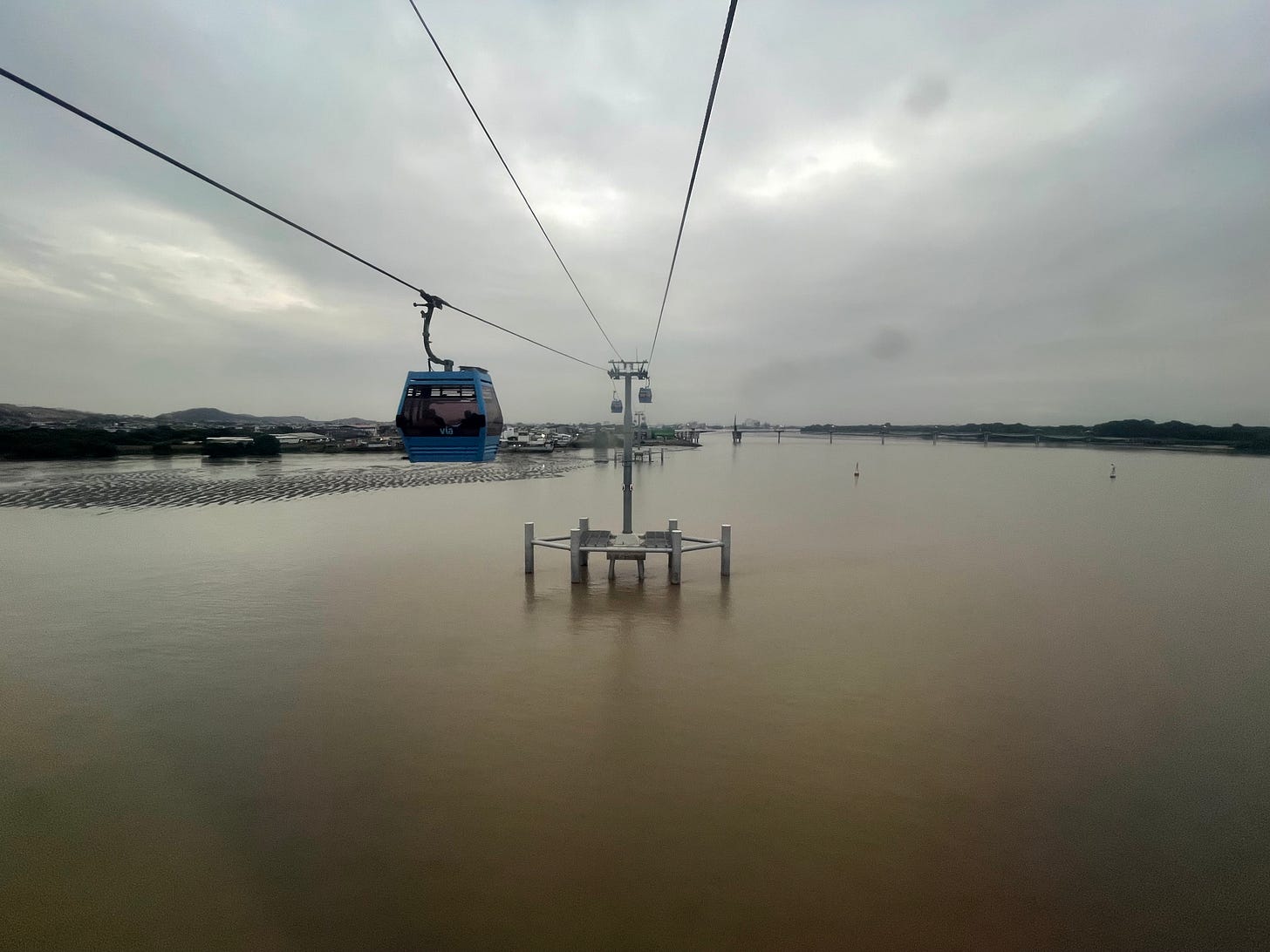
towards Duran (don’t get your hopes up—there are only two photos in this post, and they look almost identical) 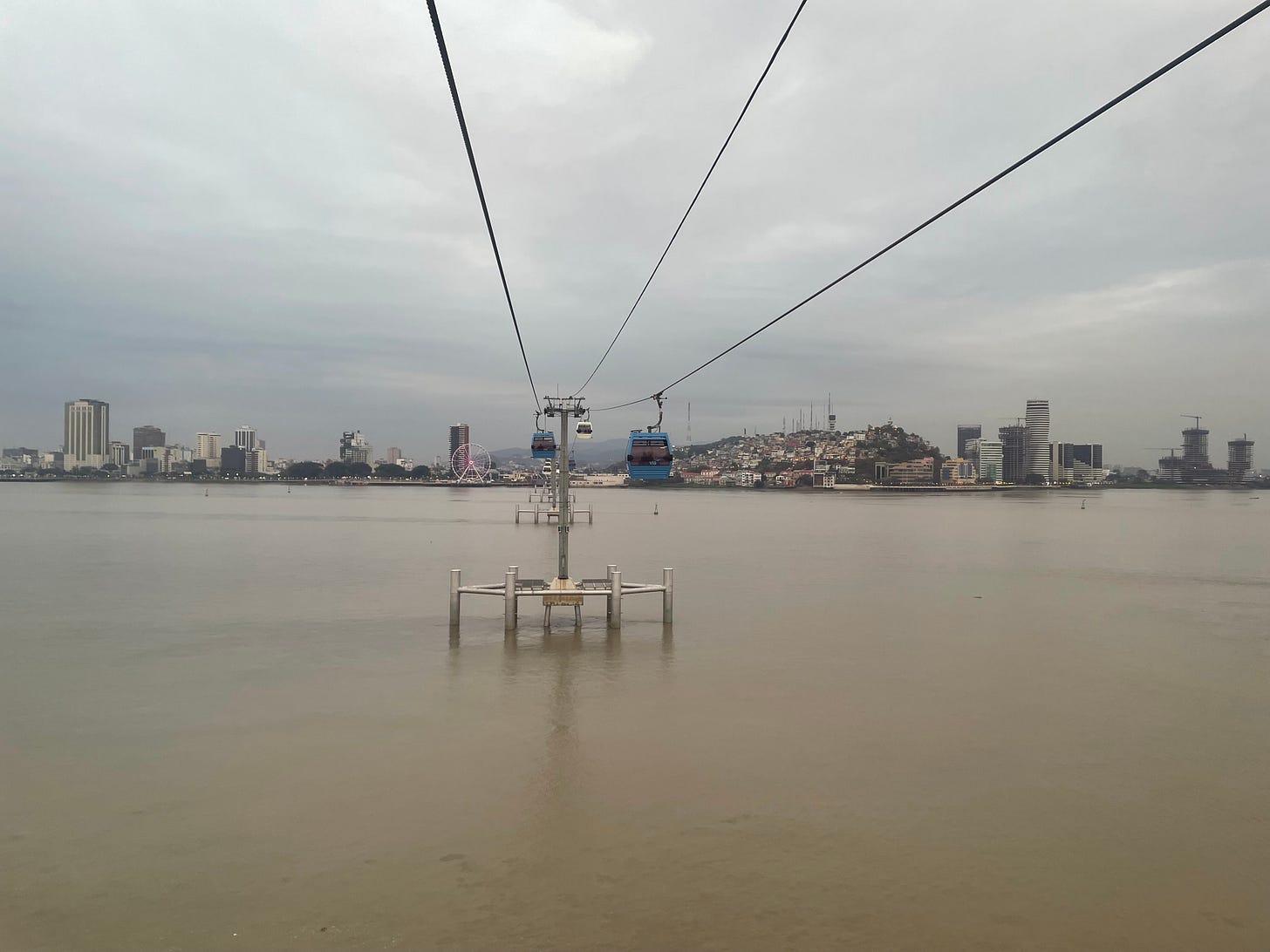
back to Guayaquil (yes, it was cloudy the whole weekend) Starbucks is not allowed in Ecuador because everybody is loyal to their own homegrown coffeeshop chain, Sweet & Coffee, which started in Guayaquil but now has over 150 locations. There’s even one in Chile. I poked around in the flagship store and can confirm that it’s superior to Starbucks (I didn’t try anything; I haven’t had coffee since 2011).
The president of Ecuador is RFK Jr.’s godson. I think? Something like that. Somebody is somebody’s godson, and it’s very nice for them, and very special.
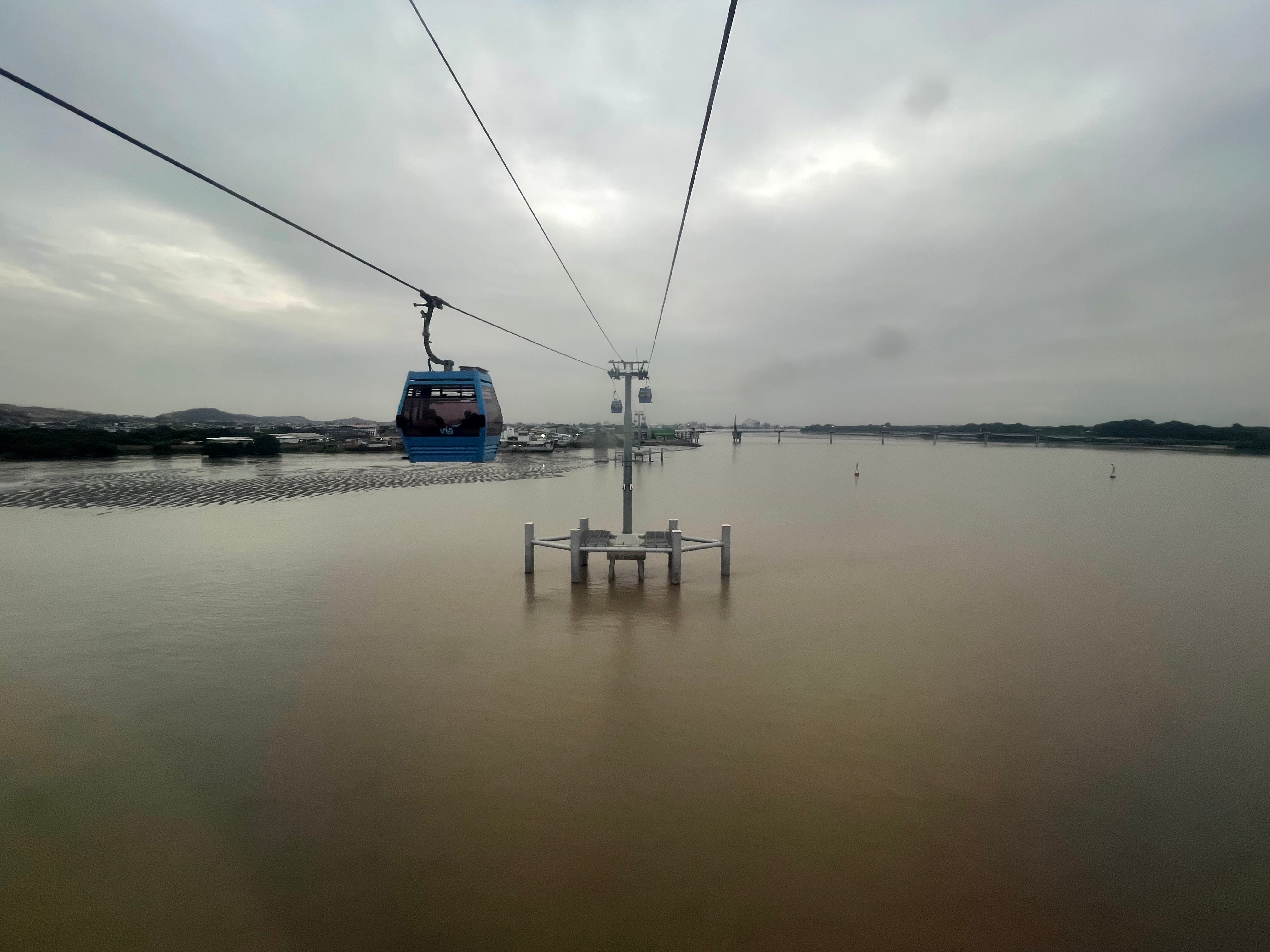
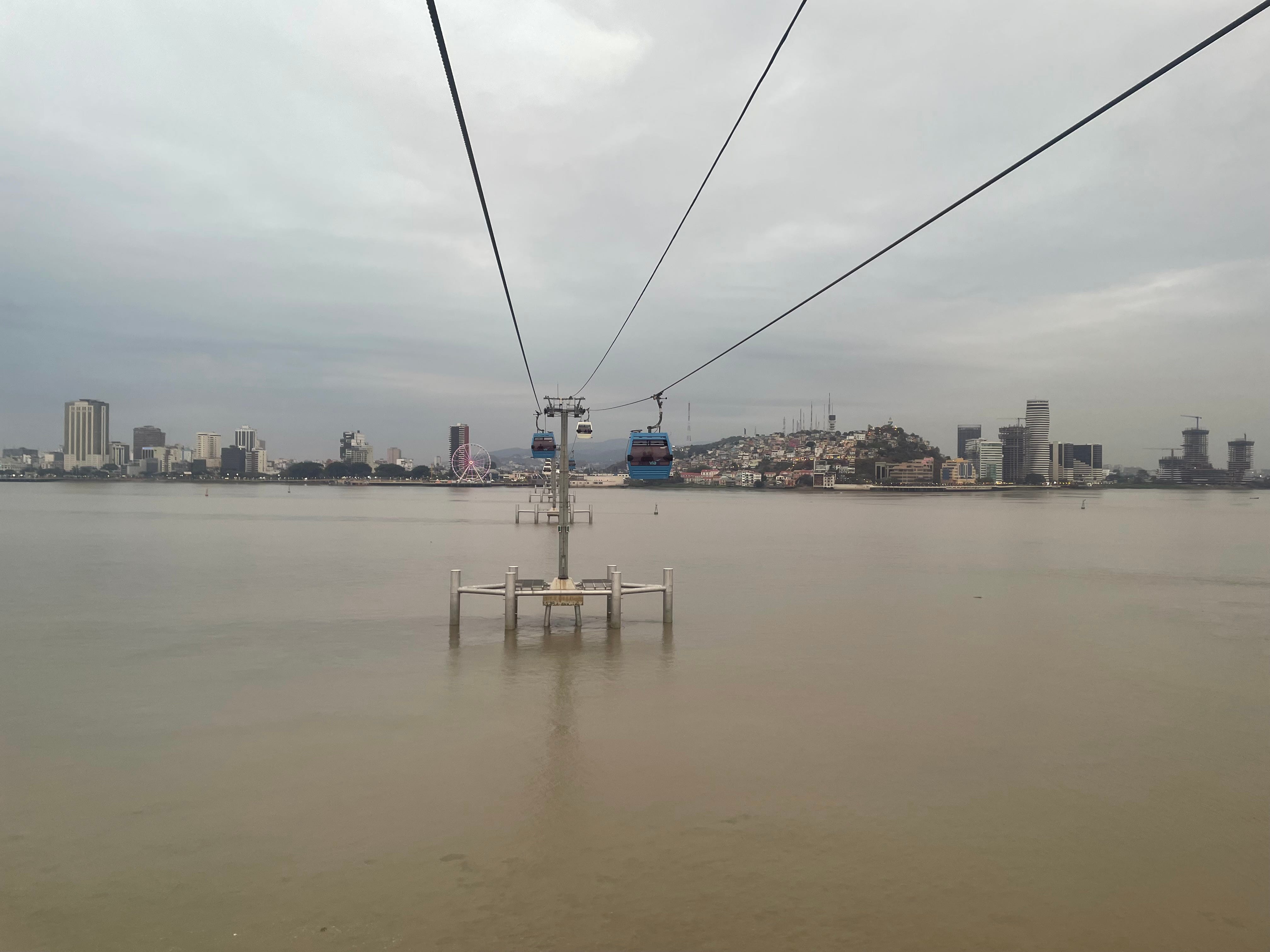
The last tidbit I’ll share about Guayaquil is that I love the definition of insanity where it’s “doing the same thing over and over, but expecting different results.” I love that definition because it’s dumb and I disagree with it, which can be exciting. Systems and their outputs are influenced by more variables than one person’s inputs. So yes, I’m big on doing the same thing over and over, and boy do I expect different results sometimes. Guayaquil validated this concept in the following ways:
I called an Uber. Credit card was not recognized. I called the Uber again. Credit card was immediately recognized.
I memorized the directions to Tía, a local grocery store, so that I could get there without having my phone out. I embarked. Several minutes passed, and I did not arrive, indicating perhaps some error may have been committed. I retraced my steps and reached the hotel. I ventured back out without re-consulting the directions. I arrived at Tía in about a minute and a half (if you’re wondering how I got lost in the first place given that it was so close, that’s fair enough, I don’t have an explanation).
I asked one of the front desk workers a question in Spanish. She didn’t understand me. It was an important question, so I asked it again, pretty much the exact same way. She understood and answered, “Yes, another guest found your missing room key and dropped it off here. You should be careful” (approximate translation).
I guess the lesson here is that there are times when it’s beneficial to follow the herd (proceeding judiciously in an unfamiliar city, collectively agreeing to use pseudo-coinage), and there are times when conventional wisdom ought to be spurned (bridges as the superior way to cross a river, the notion that trying again means you’re crazy crazy).
Anyways, much love, Guayaquil. Next stop, maybe, an island, or even possibly a certain chain of them, perhaps, yes, some might say, an archipelago.
Insanely,
Drew